What Affects the Cost of Packaging Design for Your Product?
Two quotes for packaging design can look very different, even for the same product. This guide explains the main packaging design cost factors in simple words, so you can plan a budget and compare quotes fairly.
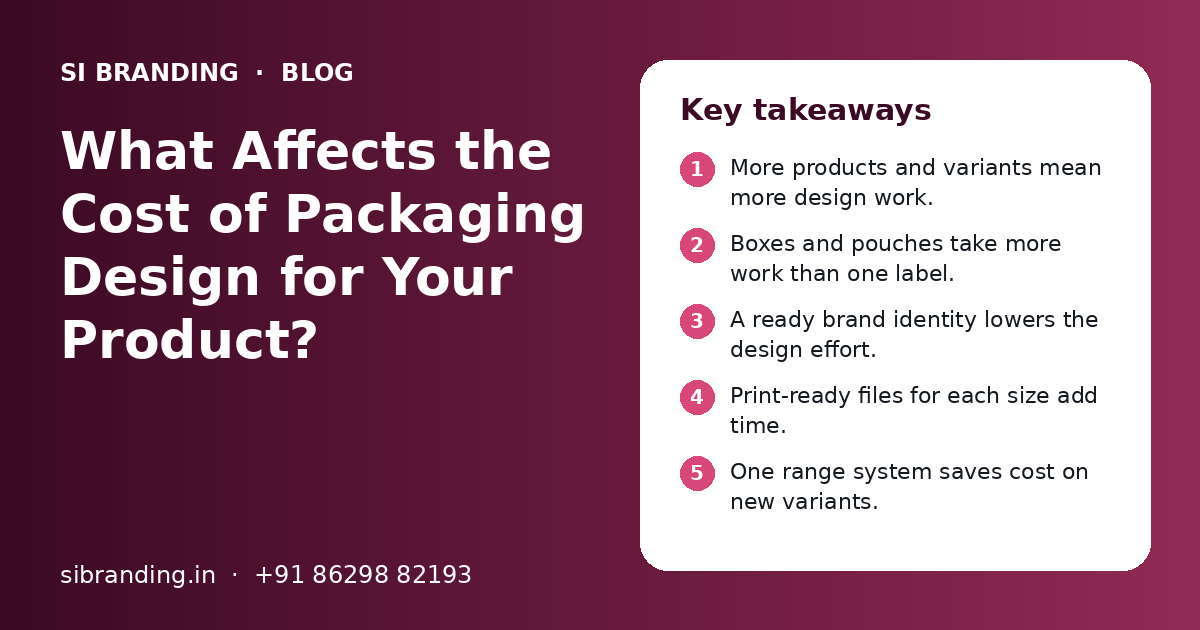
What affects the cost of packaging design?
The main packaging design cost factors are the number of products and variants, the pack types and sizes, how much research and concept work is needed, whether you already have a brand identity, mockups and 3D renders, print-ready files for each dieline, the number of revisions and the deadline. You get a clear quote after a free call.
Key takeaways
- More products and variants mean more design work.
- Boxes and pouches take more work than one label.
- A ready brand identity lowers the design effort.
- Print-ready files for each size add time.
- One range system saves cost on new variants.
- Compare quotes on what is included.
What does packaging design cost actually cover?
Packaging design cost covers the designer's time to plan, create and prepare your pack artwork for printing. It does not usually include the printing itself, the material or the boxes.
Before you look at the packaging design cost factors, it helps to know what a typical project includes. Some agencies quote all of these together. Others quote each part on its own.
Research and brief
Understanding your product, buyers, shelf and online competitors.
Concepts
Two or more design directions for the main pack.
Refinement
Changes to the chosen concept after your feedback.
Adaptation
Applying the final design to other sizes and variants.
Print files
Artwork set on the printer's dieline, with correct colours and bleed.
Mockups
Realistic images for your website, marketplace listings and social media.
At SI Branding, our packaging design services cover labels, boxes, pouches and jars. Before any work starts, you get a clear quote after a free call, with a list of what is included.
Which packaging design cost factors matter most?
The number of products and variants, the type of pack and how much new thinking is needed matter most. Mockups, print files, revisions and deadlines also change the cost.
The table below shows the main factors in one place. Use it as a checklist when you read a quote.
| Cost factor | What pushes cost up | What keeps cost down |
|---|---|---|
| Number of products | Many different products, each with its own look | One product first, others later |
| Variants and flavours | Each variant designed from scratch | One system with colour coding for variants |
| Pack type | Boxes, cartons and pouches with many panels | A single front label |
| Sizes | Many sizes, each with its own dieline | Fewer sizes, planned early |
| Brand identity | No logo, colours or fonts yet | A ready logo and brand guide |
| Research and concepts | Many concept routes and deep competitor study | Clear brief and two focused concepts |
| Illustration or photography | Custom illustrations or product shoots | Simple graphic style or your own photos |
| Mockups and 3D renders | Many angles and scenes for every variant | Only key mockups for launch |
| Revisions | Open-ended changes from many people | Agreed rounds and one decision maker |
| Deadline | Rush delivery for a launch or trade fair | A realistic timeline agreed early |
Each factor is explained in more detail below.
How do the number of products and variants change the cost?
Every new product, flavour, size or language version adds design and file work. A range planned as one system costs less per variant than designing each pack on its own.
Say you sell three masala blends in two pouch sizes. That is six pack files, even if the design looks the same. Each one needs its own name, colour cue, back panel text and print file. If you add Hindi or a regional language on the pack, the work grows again.
Why a range system saves money
A range system is a fixed layout with rules. The logo, product name and key details always sit in the same place. Only the colour, image or flavour name changes. Once the system is ready, a new variant takes much less time than a fresh design.
- Design the hero product first, with the full range in mind
- Set colour coding for flavours, strengths or sizes
- Fix where the logo, name, claim and legal text will sit
- Write the rules down in a simple guide for future variants
Our brand guidelines service can include packaging rules, so your printer or in-house team can follow them later.
Does the type of pack affect packaging design cost?
Yes. A simple front label needs less work than a box, carton or pouch with many panels, folds and print areas. More panels mean more layout work and more checks.
| Pack type | Design work involved | Effort level |
|---|---|---|
| Front label only | One panel, brand, product name and key details | Lower |
| Front and back labels | Two panels, including ingredients, usage and legal text | Medium |
| Wrap-around label | Curved surface, care with text near the seam | Medium |
| Stand-up pouch | Front, back and gusset, often with a window or zip area | Medium to high |
| Folding box or carton | Six or more panels, flaps and the dieline | High |
| Gift box or rigid box | Outer box, inner tray, sleeve, special finishes | High |
| Shipping box for D2C | Outer print, inside print, stickers and tape | Medium to high |
If you only need labels for bottles, jars or tubes, our product label design service may be enough. For snacks, spices, sweets and drinks, see our food packaging design page, where pack material and space for required details matter a lot.
Does having a brand identity lower the cost?
Usually, yes. If your logo, colours and fonts are already fixed, the designer can focus on the pack. If they are not, brand identity work must come first, and that adds time and cost.
Many new brands start with packaging and only then realise they do not have a final logo or colour palette. The designer then has to make brand decisions while designing the pack. This often leads to more rounds of changes.
When you already have a brand identity
- The designer works from a clear logo, colours and fonts
- Fewer concept routes are needed
- Packs match your website and social media from day one
- Feedback is faster because the style is already agreed
When you do not
- Logo and colour choices must be made first
- More concept rounds and more feedback calls
- Risk of the pack and the brand going in different directions
- A higher total quote, because two jobs are combined
If you are at this stage, start with brand identity design and then move to packaging. D2C founders can see our D2C brand identity page for a combined plan.
How do print requirements change the cost?
Print-ready files take careful work. Each size needs artwork set on the printer's dieline, with correct bleed, colour settings and text sizes. Special finishes add extra file layers.
Many owners think the design is done once they like the look on screen. But the files must also work at the printing press. Mistakes here are costly, because a wrong print run wastes material and money.
- Get the dieline from your printer before design starts
- Confirm the material: paper, board, plastic film, foil or glass
- Confirm the print method and number of colours
- Ask if spot UV, foil stamping or embossing is planned
- Check the barcode size and position if you need one
- Leave readable space for net quantity, MRP, dates and FSSAI details where they apply
- Ask for a printed proof before the full run
Every special finish, like foil or spot UV, needs its own separate file layer. Each new dieline means fresh checks. That is why a quote for print-ready files across many sizes is higher than a quote for one size.
How do mockups, revisions and deadlines affect the price?
More mockups, more revision rounds and shorter deadlines all take more design time. Agreeing these early keeps the quote stable.
Mockups and 3D renders
Mockups show your pack on a shelf, in a hand or on a plain background. You need them for Amazon, Flipkart and your own online store, often before the first print run is ready. A few mockups for launch are enough for most brands. A full set for every variant and angle takes longer.
Revisions
Most quotes include a fixed number of revision rounds. Feedback from many people, in many WhatsApp groups, often leads to extra rounds. Name one person who gives final approval, and collect all comments in one place.
Deadlines
A rush deadline, such as a festive launch or a trade fair, may need the team to move other work around. Plan packaging early. Our guide on how long a branding project takes shows how to plan stages before a launch date.
How can you plan a packaging design budget?
Start with your hero product, plan the range as one system, and get your printer's details ready. Then share a clear brief and compare quotes on what they include.
- 1
List your products and variants
Write down every product, flavour and size you plan to sell in the next year, and mark which ones launch first.
- 2
Pick your pack types
Note whether each product needs a label, pouch, box or a mix. Check with your printer or supplier.
- 3
Collect your brand files
Share your logo, colours, fonts and any brand guide. If you do not have these, say so in the brief.
- 4
Get printer details
Ask your printer for the dieline, material and print method for each pack.
- 5
Gather the label text
Prepare product names, ingredients, usage, claims, legal details and any language needs.
- 6
Ask for a phased quote
Ask for the hero pack first, then the rest of the range, so you can spread the cost.
- 7
Compare what is included
Check concepts, revision rounds, mockups, print files and support during printing.
For a broader look at budgets, our page on logo design cost in India explains how scope changes design cost in a similar way.
What should you ask before you accept a packaging design quote?
Ask what is included, how many concepts and revisions you get, whether print files for every size are covered and who owns the final files.
- How many design concepts will I see?
- How many revision rounds are included?
- Are print-ready files for every size and variant included?
- Will you work on my printer's dieline?
- Are mockups for my website and marketplaces included?
- Do you help check the printer's proof?
- Will I get the editable source files?
- Is printing included, or paid to the printer separately?
- How do invoices and GST work?
SI Branding is powered by Shivah Web Tech, with an 11+ year parent team, 25+ in-house team members and 500+ projects. We are MSME registered and work with brands in India, USA, UK, Canada, UAE and Australia. Book a free call through our contact page, share your products and pack types, and get a clear quote that lists exactly what is included.
Related Pages
Packaging Design
Labels, boxes and pouches that sell on shelves and online.
Food Packaging Design
Pouches, jars, boxes and labels for food and snack brands.
Label Design
Product labels for jars, bottles, tubes and boxes, ready to print.
Brand Identity
Logo, colours, fonts and image style that work together.
Frequently Asked Questions
How much does packaging design cost in India?
There is no single price, because the cost depends on the number of products, variants, pack types, sizes, mockups and print files you need. One front label costs far less than a full range of boxes and pouches. The best way to know the real cost is to share a short brief and get a clear quote after a free call.
Is printing included in the packaging design cost?
Usually not. The design fee covers concepts, refinement, adaptation and print-ready files. Printing, material, box making and delivery are normally paid to your printer or packaging supplier. Some designers help check the printer's proof. Ask your designer to write down clearly what is included, so you can plan both budgets.
Why do packaging design quotes vary so much?
Quotes vary because providers include different things. One may include research, three concepts, several revision rounds, mockups and print files for every size. Another may only design one front panel. Share the same brief with each provider, then compare the list of deliverables, not just the final number.
Is it cheaper to design labels than boxes?
In most cases, yes. A label has fewer panels and less layout work than a folding box, carton or pouch. A box has many sides, flaps and a more complex dieline, and each side needs checking. If your product works well with a label on a ready-made container, it can lower the design effort.
How can I reduce the cost of packaging design?
Start with your hero product and plan the full range as one system. Have your logo and colours ready, get your printer's dieline early and prepare all label text before design starts. Name one person to approve work and collect feedback in one place. These steps cut extra rounds, which are a common hidden cost.
Does packaging redesign cost less than new packaging?
It depends on how big the change is. A light refresh that keeps your logo, colours and layout and only fixes clarity can need less work. A full redesign with a new look across every variant is closer to a new project. Share your current packs and goals on a call to get a clear quote.
Do I need a brand identity before packaging design?
It helps a lot. With a ready logo, colours and fonts, the designer can focus on the pack and you see fewer rounds of change. Without them, brand choices must be made first. Many new brands do both together, starting with the brand identity and then moving on to the hero pack.
Can I add new variants later without paying for a full design?
Yes, if your packaging was built as a range system with clear rules. A new flavour or size then follows the same layout, with a new colour, name and details. This takes much less time than a fresh design. Ask your designer to set up the system and write the rules down.
Talk to our team today
Call or WhatsApp +91 86298 82193. We reply fast, Monday to Friday.